In this article
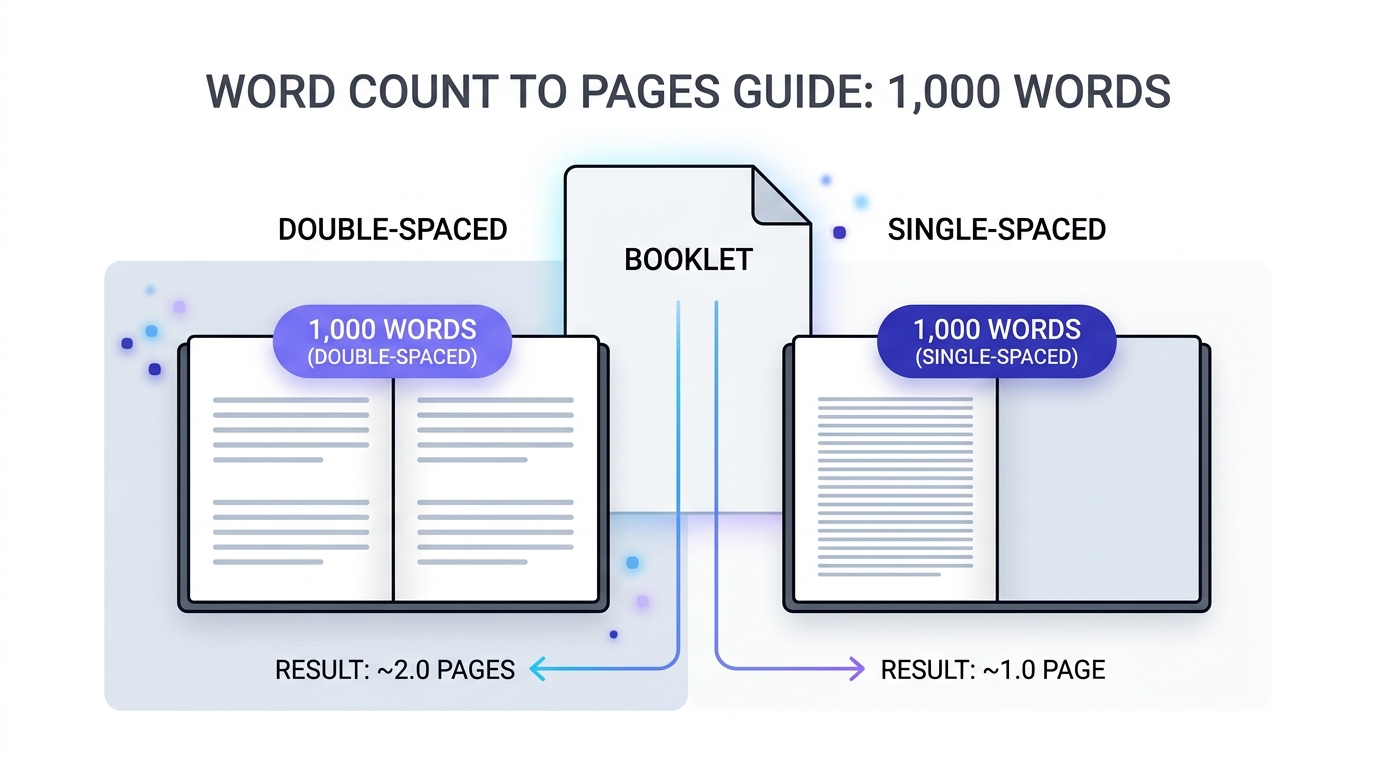
With standard formatting, 1,000 words fills about two pages single-spaced or four pages double-spaced. “Standard” here means a 12-point font such as Times New Roman or Arial, 1-inch (2.54 cm) margins, and A4 or US Letter paper.
These are estimates. The exact figure moves with font, spacing and how the text is broken up, which is why assignments usually specify a word count rather than a page count.
Words to pages conversion table
| Words | Single-spaced | Double-spaced | Reading time |
|---|---|---|---|
| 250 | ½ page | 1 page | about 1 min |
| 500 | 1 page | 2 pages | about 2 min |
| 750 | 1½ pages | 3 pages | about 3 min |
| 1,000 | 2 pages | 4 pages | 4–5 min |
| 1,500 | 3 pages | 6 pages | 6–7 min |
| 2,000 | 4 pages | 8 pages | 8–10 min |
| 2,500 | 5 pages | 10 pages | 10–12 min |
| 3,000 | 6 pages | 12 pages | 12–15 min |
| 5,000 | 10 pages | 20 pages | 20–25 min |
| 10,000 | 20 pages | 40 pages | 40–50 min |
Reading times assume roughly 200 to 250 words per minute.
What changes the page count
- Line spacing has the largest effect. Double spacing doubles the length; 1.5 spacing sits halfway.
- Font and size. At the same point size, Arial and Verdana are wider than Times New Roman and Calibri, so they fill pages faster. Moving from 12-point to 11-point fits noticeably more on a page.
- Margins. Narrow margins fit more words; wide ones fit fewer.
- Structure. Headings, short paragraphs, bullet lists, block quotations, tables and images all add space. A report with frequent headings can run a third longer than plain prose of the same word count.
- Paper size. A4 is slightly narrower and taller than US Letter. The difference is small, usually a few lines per page.
How long is that when spoken?
For speeches and presentations, a comfortable pace is about 130 to 150 words per minute. That makes 1,000 words roughly seven minutes of speaking. Work backwards for a time slot: a five-minute talk needs about 650 to 750 words, and a ten-minute talk about 1,300 to 1,500.
Check your own count
To see exactly where you stand, paste your text into the Word Counter. It shows words, characters with and without spaces, sentences, paragraphs, and estimated reading and speaking time as you type.
In a word processor:
- Microsoft Word: the count appears in the status bar at the bottom; click it for details. Select a passage to count just that part.
- Google Docs: choose Tools → Word count, or press Ctrl+Shift+C (Cmd+Shift+C on a Mac).
- Apple Pages: choose View → Show Word Count.
Writing to a word limit
- Over the limit? Cut whole points before trimming individual words. Removing your weakest paragraph improves the piece and saves a hundred words at once. Then delete introductions that restate the question and conclusions that repeat the body.
- Under the limit? Do not pad. Add an example, address a counter-argument, or explain a step you skipped. Readers and markers can tell the difference between development and filler.
- Know the tolerance. Many institutions accept a margin of around 10% either side, but some enforce the stated limit strictly. Check before relying on it.
Frequently asked questions
How many words is one page?
With a 12-point font and 1-inch margins, roughly 500 words single-spaced or 250 words double-spaced. Headings, short paragraphs, lists and images all reduce that.
How long does it take to read 1,000 words?
About four to five minutes at a typical adult silent reading speed of 200 to 250 words per minute. Read aloud at a presentation pace, it takes around seven minutes.
Do headings, footnotes and references count towards a word limit?
It depends on who set the limit. Many universities exclude the reference list and sometimes footnotes and appendices but include headings and quotations. Always check the specific guidelines you were given.